
How the Standards Program Works
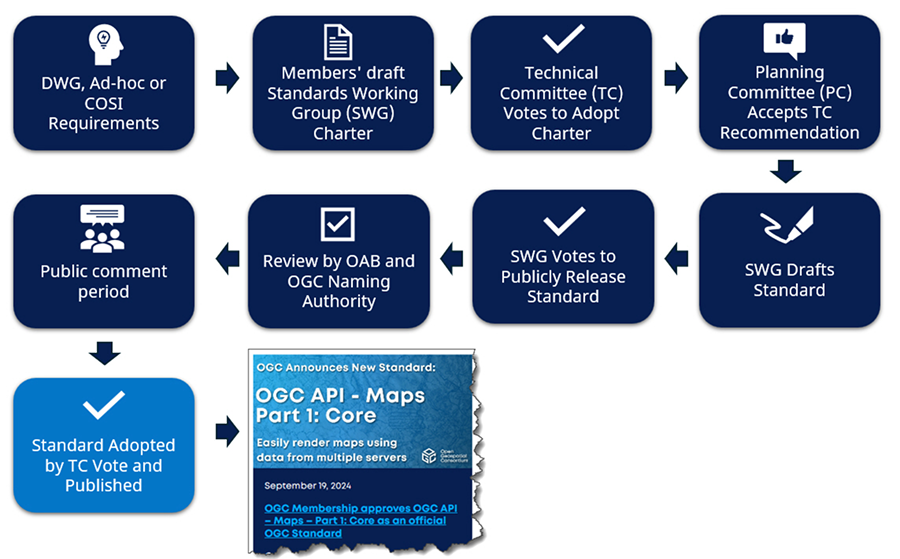
Every OGC Standard is built through a collaborative and rigorous process, where working groups identify interoperability needs and develop them into standards for global adoption.
Certified to Connect. Built to Interoperate.
OGC Standards Program
A dynamic, rigorous process is behind the creation of every OGC Standard. It starts with our working groups, connecting with each other through Agora (Member Community).
Following our Technical Committee’s procedures, Domain Working Groups identify domain-specific requirements for interoperability while Standards Working Groups bring interoperability requirements forward as standards for adoption. The Testbeds integrate requirements and ideas from a group of sponsors, which allows leveraging symbiotic effects and makes the overall initiative more attractive to both Participants and sponsoring organizations.
Collaboration in action, standards in motion.
Explore the Standards Lifecycle
Discover how OGC Standards move from idea to adoption — through collaboration, testing, and consensus that ensure global interoperability.
As standards are developed, code sprints iteratively test the work.
An OGC Code Sprint is a collaborative and inclusive event driven by innovative and rapid programming with minimal process and organization constraints to support the development of new applications and candidate Standards. Standards-based solutions are put through real-world scenarios to document their use in a context understandable by the wider community.
Compliance tests are run to ensure that software and systems are reliable and interoperable through adherence to OGC standards.
Three Types of Standard
- Encoding standards provide rules that determine how to organize information, typically sent by a service provider, or produced by an application.
- Interface Standards provide rules that determine the operations between service providers and service requesters. Together, these standards define interoperable approaches to geospatial data organization, access, processing, visualization, and discovery.
- Conceptual Model Standards describe common concepts and their relationships to facilitate the exchange of information between parties within a specific domain.
Three Levels of Standard
- Community Standard: This is a document, developed by communities external to the OGC, that OGC members wish to bring into the OGC process. The key consideration for a Community Standard submission is that there is very strong evidence of implementation.
- Draft Standard: This is a document developed by the OGC membership for which there is no evidence of implementation. Members seek to approve it as an official OGC document in order to have developers and organizations implement the Draft Standard and provide feedback. A Draft Standard becomes a Standard once evidence for implementation is provided.
- Standard: This is a mature OGC Standard for which there is evidence of implementation.
Standards are dynamic: They evolve as technology changes and are retired when they’re no longer in use. For example, the evolution of OGC Web Service Standards has led to the development of new OGC API Standards. OGC APIs make it easy for anyone to leverage geospatial information on the web and to integrate it with other types of data.
We chart the development of each Standard through a roadmap that offers both a Status View and a Gantt view.
Open Calls and Requests
Members of the public can review candidate standards and share feedback to ensure they are practical and widely applicable.
Request For Comment (RFC)
OGC Seeks Public Comment on Candidate OGC SensorThings API Extension: WebSub Asynchronous Messaging Standard